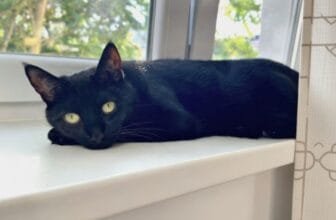
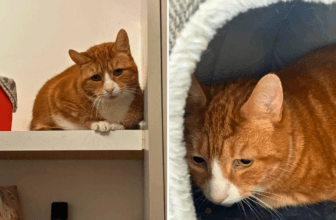
In honor of Activist Appreciation Month, we spoke with LeesaMaree Bleicher, a longtime animal advocate deeply involved with community cat rescue for more than 25 years. A survivor-advocate of human trafficking and currently pursuing a PhD in psychology, LeesaMaree brings a trauma-informed perspective to her work. She challenges widely held narratives by emphasizing that homeless community cats are not feral, but domesticated animals dependent on human care for survival.
Mini-Grant Recipient: Deaf homeless cat with ear cancer in San Francisco, California, gets medical treatment from LeesaMaree Bleicher with grant funds.
An Interview with Animal Advocate LeesaMaree Bleicher
In Defense of Animals (IDA): You’ve said your work doesn’t replace TNR—it builds on it. Can you explain what that means?
Trap-Neuter-Return is necessary for population control, but it does not save cats’ lives. Lives are saved by fully operational, trauma-informed community cat programs that support both cats and the people caring for them in neighborhoods most affected by disability, violence, and economic instability. Expecting residents facing these challenges to navigate fragmented systems is unrealistic and inequitable. What is needed is a coordinated, community-based response dedicated to relieving suffering and saving cats’ lives.
What obstacles do rescuers and advocates face when trying to apply this kind of care?
Institutional resistance driven by outdated practices. Many systems label homeless community cats as “feral,” a narrative that is misleading and harmful. Cats are not feral; they are domesticated, displaced by human systems. Homelessness is traumatic for people; the same applies to cats. Trauma-related behaviors are misinterpreted as inherent aggression rather than normal responses to fear and deprivation.
Trauma-informed care is evidence-based and widely used across social systems; it remains absent from animal welfare practice. Most shelters rely on rigid behavior assessments and intake-driven metrics rather than individualized, trauma-responsive care. This limits innovation, reinforces outdated practices, and delays adoption of a model that would improve the lives of homeless cats.
How can shelters, rescuers, and advocates work together more effectively?
Shelters must recognize that the historical approach to homeless community cats is outdated and no longer sufficient. The crisis of homeless community cats has reached the level of a public health crisis and must be treated as such.
Shelters and advocates must work together, with lived experience recognized as expertise, to create a true continuum of care for cats.
What message would you leave with animal welfare professionals and advocates?
Trauma-informed care is the answer. It asks us to see cats not as feral but as gentle, sentient beings whose lives are impacted by trauma and human systems, and to respond accordingly. This is a call to justice, an act of mercy, to end the suffering of homeless cats.
To learn more and take action, visit:
idausa.org/campaign/community-cats
LeesaMaree Bleicher is a recipient of a mini-grant as part of In Defense of Animals’ Activist Appreciation Month.
Meet Milo
Milo is an exceptionally loving people-centered cat who appeared in LeesaMaree’s San Francisco neighborhood in unbelievably bad condition. Children were chasing him, and he was starving; you can feel his bones. Despite the trauma Milo has endured, he is incredibly gentle, affectionate, and trusting — the kind of cat who leans into touch and clearly wants love and comfort.
Milo has tested FeLV-positive, but recent research and updated veterinary guidance are much more hopeful than in years past, showing that FeLV is less easily transmitted than once believed and that many FeLV+ cats can live meaningful, comfortable lives with the right care and environment.
We know that Milo would thrive and live a happy life with the right person to care for him.
If you can give Milo a loving forever home, or if you would be willing to foster him long-term, please send a message to michaelangelo@idausa.org.